The Science of Revenge Trading: Why Your Brain Sabotages You After a Loss (and What the Data Actually Says)
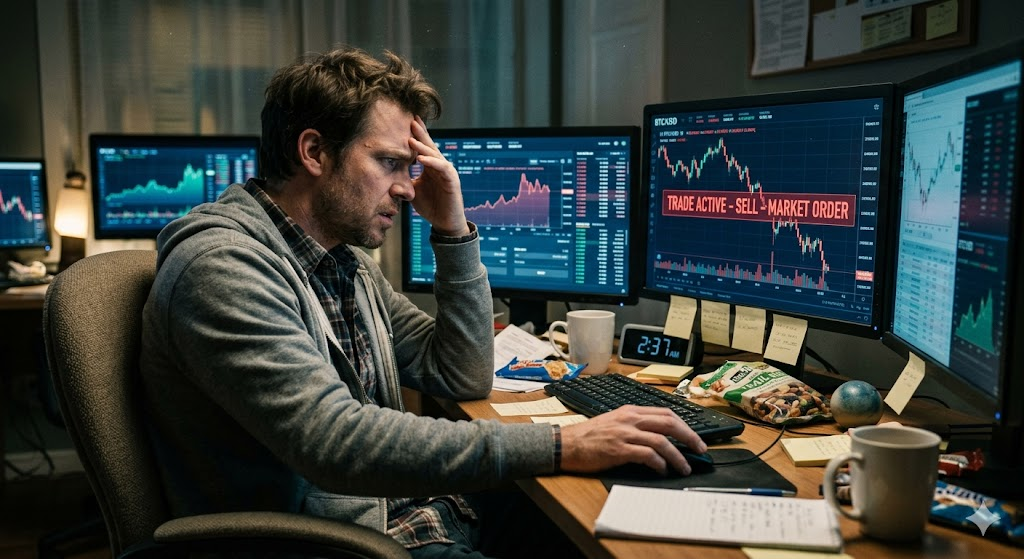
Every trader has done it. The market takes your money, your jaw clenches, and before you can stop yourself, you're clicking buy on a setup you would have laughed at thirty minutes ago. Welcome to revenge trading — the most expensive emotion in finance, and one of the most thoroughly studied phenomena in behavioral economics.
TL;DR
- Losses hurt roughly twice as much as equivalent gains feel good (Kahneman & Tversky, 1979).
- One study tracked revenge trades at a 22% win rate, costing one trader $4,200/month.
- Chronic cortisol exposure can drop a trader's risk premium tolerance by 44% (Coates et al., Cambridge).
- Retail traders sell winners ~60% more often than losers — and the winners they dump go on to outperform (Odean, 1998).
- A simple 30-minute cooldown rule eliminated 93% of revenge trades in one documented case.
What Revenge Trading Actually Is (Beyond the Obvious)
Revenge trading is the act of entering a new trade — or aggressively re-entering the same market — driven primarily by the desire to recover a recent loss, rather than by a valid signal. The defining characteristic isn't the trade itself; it's the motivation. The trader has stopped trading the market and started trading their own P&L statement. Poker players call the same phenomenon "tilt." It's a behavioral response, not a technical error, and it's rooted in cognitive biases that have been measured in laboratories for decades. [source]
The reason it deserves a proper deep dive — and not another "control your emotions, bro" listicle — is that the underlying mechanisms are surprisingly well-documented. We can put numbers on this. We can point at brain chemistry. We can show you a chart that ruined someone's career. And once you see the machinery, the urge to revenge trade loses some of its grip.
The Foundation: Prospect Theory and Why Losses Hurt Twice as Much
In 1979, two Israeli psychologists named Daniel Kahneman and Amos Tversky published a paper in Econometrica titled "Prospect Theory: An Analysis of Decision under Risk." It went on to become the most-cited paper ever published in that journal and eventually earned Kahneman the 2002 Nobel Memorial Prize in Economics. (Tversky had died in 1996 and was therefore ineligible — the Nobel committee, in a rare moment of class, acknowledged his co-authorship explicitly.) [source]
The paper demolished the prevailing assumption — expected utility theory — that humans rationally evaluate gambles by their expected mathematical value. Kahneman and Tversky showed empirically that we don't. Instead, we evaluate outcomes as changes from a reference point (usually our entry price, in trading terms), and our pain from losses is roughly twice as intense as our pleasure from equivalent gains. The technical term is loss aversion, and it's been replicated across cultures, income levels, and decision contexts ever since. A 2022 global replication study confirmed the original findings in roughly 90% of tests across dozens of countries. [source]
In trader-speak: losing $500 hurts about as badly as missing out on a $1,000 gain feels good. Your brain isn't broken — it's working exactly as evolution designed it. Unfortunately, evolution did not have day-trading SPY contracts in mind.
Strike One: Loss Aversion Triggers the Urge to "Get It Back"
Once you understand the asymmetry, revenge trading stops looking like a character flaw and starts looking like a predictable outcome of human wiring. A $500 loss creates psychological pain roughly equivalent to a $1,000 missed gain. Your brain, frantically trying to restore equilibrium, demands action. Any action. Even mathematically stupid action. Sitting on your hands feels intolerable because doing nothing means the pain persists. [source]
This is reinforced by a related finding from Kahneman and Tversky's work called the reflection effect: when people are in the domain of losses, they become risk-seeking, not risk-averse. A trader who would never normally take a 5:1 risk on a setup will happily double their position size after a loss, because the alternative — sitting with the loss — feels worse than the prospect of a larger loss. The value function is convex on the loss side, which mathematically encodes that "double-or-nothing" feeling we all recognize.
Strike Two: Cortisol, the Stress Hormone That Quietly Hijacks Risk Perception
This is where the research gets genuinely interesting, and where most trading psychology articles tap out. In 2008, a former Goldman Sachs derivatives trader turned Cambridge neuroscientist, John Coates, published a study in PNAS measuring the actual hormone levels of real traders on a London trading floor. He found that a trader's cortisol rose in lockstep with both market volatility and the variance of their own trading results. Stressful day? Measurably elevated cortisol. Bad streak? Even higher. [source]
A follow-up 2014 study went further: Coates and colleagues artificially raised cortisol levels in healthy volunteers over an 8-day period using hydrocortisone, mimicking what real traders experience during sustained volatility. Then they had the subjects participate in financial risk-taking tasks. The result was striking. While brief cortisol spikes had little effect, chronically elevated cortisol caused the participants' risk premium tolerance to drop by 44%. In other words, after sustained stress, people demanded vastly more reward to accept the same level of risk — and they began irrationally overweighting small probabilities, exactly the kind of distortion that makes a trader chase low-odds Hail Marys after a drawdown. [source]
So when you feel like a different person after a big loss — calmer reasoning gone, conviction in setups gone, position-sizing discipline gone — you are not imagining it. Your endocrine system is, biochemically, a different person. Coates argues this is one of the underappreciated drivers of market crises: when volatility spikes hard enough for long enough, traders' bodies start refusing to take normal risks just when the market most needs liquidity providers. The Credit Crisis of 2007-09, when US equity volatility jumped from 12% to over 70%, almost certainly produced the kind of chronic cortisol elevations the Cambridge team's protocol mimicked. [source]
Strike Three: The Disposition Effect — We Hold Losers and Sell Winners
If loss aversion explains the urge to revenge trade and cortisol explains the impaired judgment, the disposition effect explains the specific shape of the damage. In 1998, finance professor Terrance Odean obtained the actual trading records of 10,000 retail accounts from a major US discount brokerage, covering 1987 to 1993. (Imagine the dataset trader-psychology pundits would kill for today.) Odean's finding has held up across decades and countries: for most of the year, retail investors are roughly 60% more likely to sell a stock that's up than a stock that's down. [source]
That's bad enough on its own. But Odean's killer follow-up finding is what makes this a knife to the heart of retail trading: the winners that investors sold went on to outperform the losers they continued to hold by about 3.4% over the following year. In other words, retail traders are systematically dumping their best ideas and clinging to their worst ones — and they're doing it because closing a green trade feels good (capturing gains validates the decision) and closing a red trade feels terrible (it forces them to admit they were wrong). [source]
This connects to revenge trading directly: after the trader finally accepts the loss they've been hiding from, the psychological pain of that delayed acceptance is much larger than if they'd cut the loss at their stop. The bigger the swallowed-pride loss, the more intense the urge to "get it back." The disposition effect doesn't just lose money on the original trade — it loads the gun for the revenge trade that follows.
The Anatomy of a Revenge Trade Cycle
Pull these threads together and you get a depressingly predictable sequence. A trader takes a loss — let's call it routine, well within their risk plan. Cortisol rises. Loss aversion kicks in, demanding action. The reflection effect tilts them toward risk-seeking behavior. Recency bias whispers that the next loss is coming. They re-enter, often larger than their rules allow, on a setup they wouldn't normally touch. Sometimes they win, which the brain encodes as confirmation that the behavior "works" — exactly the intermittent reinforcement schedule used in slot machines. Sometimes they lose, and the cycle accelerates. [source]
The intermittent-reinforcement angle is worth pausing on, because it's why this behavior is so hard to extinguish. If revenge trading lost every time, traders would quit doing it in a week. But it occasionally produces a recovery win, and that win is more psychologically reinforcing than the dozens of measured, plan-following wins that preceded it. The brain remembers the thrill of the comeback and conveniently forgets the four blowups that came before. [source]
What the Data Says About Stopping It
Here's the encouraging part: revenge trading is one of the most fixable behavioral mistakes in trading, because it has a measurable signature in journal data. One documented case study analyzed a trader's records and defined revenge trades as entries within 15 minutes of a loss, at larger-than-normal size. Those flagged trades had a 22% win rate and were costing the trader roughly $4,200 per month. A single 30-minute cooldown rule, enforced through three external commitment layers (platform-level restrictions, not just willpower), eliminated 93% of those trades. [source]
The mechanism here matters. Willpower is the worst possible defense against revenge trading, because willpower is exactly the cognitive resource that cortisol degrades. By the time you "need" willpower to not revenge trade, you have the least of it you'll have all day. Effective interventions don't rely on you being disciplined in the moment — they rely on you being disciplined before the moment, when your prefrontal cortex is still in charge.
| Intervention | Why It Works (Mechanism) | Effectiveness |
|---|---|---|
| Hard cooldown timer (15-30 min after a loss) | Lets acute cortisol begin to clear; forces space between stimulus and response | Eliminated 93% in case study |
| Daily max-loss platform lockout | Removes the option entirely; willpower not required | Standard at most prop firms for a reason |
| 2-loss rule (stop trading for the day after 2 losses) | Caps cumulative cortisol load; prevents escalation | Widely used in professional risk management |
| Pre-trade journal entry (written setup before entry) | Forces System-2 engagement; reveals revenge motivation | Reduces impulsive entries substantially |
| Physical state reset (walk, water, breathing) | Activates parasympathetic response; lowers cortisol | Modest but measurable |
Which Tools Actually Implement These Rules?
The interventions above are categories, not products. A 30-minute cooldown rule is great in theory, but without an external enforcement layer, your tilted brain will simply ignore the timer. The good news: there's now a small ecosystem of tools that operationalize each layer of defense — trading journals with built-in tilt meters (Edgewonk, TradeZella, RizeTrade), prop firm accounts whose daily loss limits you literally cannot override (FTMO, Topstep, The5%ers), broker-level loss restrictions like Interactive Brokers' "Triggered by Loss" feature, and platform blockers for the genuinely desperate.
We've assembled a separate, in-depth guide that walks through nine specific tools — what each one actually does, what it costs in 2026, where the marketing oversells the product, and how to stack them into a working anti-revenge-trading system. If you've read this far, that's the natural next step:
The Honest Limits of the Research
A few caveats are worth flagging, because trading content rarely includes them. Coates's cortisol studies have sample sizes in the dozens to low hundreds — interesting and well-designed, but not enormous. Loss aversion's classic "2:1" ratio is an empirical average; individual traders vary considerably, and some recent work has questioned whether the ratio is closer to 1.5:1 in some populations. Odean's brokerage data is from the 1987-1993 era and includes equities only, though more recent international replications (Finland, Taiwan, the Netherlands) have broadly confirmed the disposition effect. None of this overturns the headline findings — they're some of the most replicated results in behavioral finance — but anyone telling you "science proves" anything in trading psychology with absolute certainty is selling you a course.
The Bigger Picture
What separates the trading-psychology research from the trading-psychology platitudes is that the research describes mechanisms, not exhortations. "Don't revenge trade" is useless advice because it ignores the biological and cognitive forces that produce revenge trading in the first place. Telling a cortisol-flooded amygdala to "stay disciplined" is like telling a drowning person to breathe more slowly. The actual answer is to design rules, platforms, position sizes, and daily routines that respect the fact that you will not be the same person at 11:47am after a $2,000 loss that you were at 9:31am at the open. Plan for the loss-aversion-addled, cortisol-soaked, reflection-effect-tilted version of yourself, because that's the version of you who will actually be at the keyboard when it matters.
The market doesn't care about your previous trade. Your brain does. The whole project of becoming a consistently profitable trader is, in some real sense, learning to act more like the market and less like your brain.
Related reading on TrailingStopLoss.com
- 9 Tools That Actually Stop Revenge Trading — the practical, product-by-product companion to this deep dive.
- More articles in our Trading Psychology category
- Day Trading guides & setups
- Prop firm rules and how risk caps are designed
- Trading Education hub